


home
new work
available
archives
biography
press
catalogues new
kindertotentanz
contact
DEJA VUE
Review, 2000
DEJA-VU: REMEMBRANCES OF PAST JOURNEYS, 1998-2000
David Haughton has made a significant contribution to his growing body of work with Deja-Vu: Remembrances of Past Journeys. Based on an extensive collection of pencil drawings he created while travelling through Europe during the 1980s, this new series seems to capture in acrylics the essence of memory itself.
Haughton brings us the loose and calligraphic lines of Greece with its abrupt and rocky islands; towering Normandy cliffs against the sea; the yellow ochres of fields in France and the deep red clay hills of Italy. There are vistas of roads through Spain, Moorish mountain fortresses in Northern Africa and a flash of Hungary. The images are very small in scale, like real lived moments more than memoirs. We¹re given glimpses of the sea between deep V-shaped hills, or, in the Ksours and Kasbah (Afternoon Light) paintings, silent views of ancient buildings between strong foreground branches. With the exception of several panoramic long views of Castille, Spain, most formats are more square than horizontal. Buildings, walls and trees feel tucked into their landscapes: his imagery goes in, on a z axis, rather than sideways.
In the series Stone Walls and Fields, the images give a wonderful tangled impression of boulders pushing out through dry grasses. In this, they are more about shape and space than the kinds of intense forms and colours in earlier work. At his best, Haughton projects deep layers of imagery receding back plane by plane, as he has done in House with Blue Gate and Through the Vines.
He is a master of negative spaces. These have as much to say in his work as the positive. A church on a hill becomes, instead, a pattern of windows punctuating an opening in the hills. The opening in the hills becomes, in turn, the silhouette of a chapel. In Chapel with Eucalyptus Trees (Afternoon), the spaces between the branches of the trees are more emphatic than the branches themselves. In paintings like Triptych/Grand Canal or Village with Dovecotes, the buildings are dotted with Haughton¹s enchanting iconography for windows: quick jots of casually aligned spaces.
This palette is entirely southern in feel, with a range of Mediterranean blues predominating: turquoise, cerulean, manganese and aquamarine against the deep yellows and crimson reds. Dry surfaces in works like View from the Ridge I and II are scumbled like the aging, crumbling walls themselves. By conjouring the rough, dry plaster and clay of the walls and turrets, these paintings appear to absorb light rather than reflect it. This quality gives them as intensely arid a sensation as his previous paintings of the British Columbia coastal region area felt drenched and cold. Again, Haughton reveals his drawing skills in blithe touches that run like mice along the delicate outlines of forms. His lines show an absolute joy in their curves and pauses. Foliage, walls, dwellings or paths are loose yielding clumps of colour, defined here and there with a stroke or two of contoured edge. Thin fleshy washes define skin-like stretched hills, like mounds of softly kneaded colour. The paintings appear full of unconsummated longing and desire, yearning and reaching.
Rambling, picaresque, framed by his roving eye, Deja-Vu is less about drama and more about description. Perhaps because each image is singular rather than part of a diptych or triptych, they have more depth of picture plane. However, the bronze, box-like frames that enclose them affirm their status as art objects rather than windows to the world.
Mia Johnson,
Vancouver 2000
Return to Press
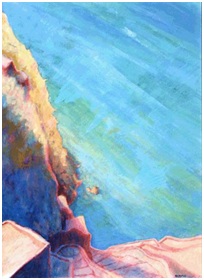
View from the Edge
(Early Morning)
Santorini, Greece
Copyright David Haughton 2002-2010
Website by KitsMedia.ca