


home
new work
available
archives
biography
press
catalogues new
kindertotentanz
contact
SHIPS, MOUNTAINS AND THE SEA
Review 1998
The paintings of Vancouver artist David Haughton are enigmatic in form and style. Like those of Richard Diebenkorn and Stuart Davis, who sought to find an artistic language that would express the borderline between descriptive and autonomous painting, they represent a juxtaposition of the rational and emotional, the structural and expressive.
His formats are divided into compositional panels and he frequently takes a strong design approach to the delineation of subject matter. His painting techniques, by contrast, incorporate both sweeping brushwork and more deliberate handling. At the point where the subject matter becomes recognizable, his compositions are cropped. As their subjects begin to coalesce with meaning, he exchanges a representational approach for a painterly one. The twist and turn of his techniques command the kind of attention normally reserved for paintings several times the scale.
In this new series of images, Haughton accomplishes two difficult tasks. When he is depicting views from shore to shore, or panoramas of the shores as they appear from the sea, he goes directly to the heart of the Georgia Strait atmosphere with its towering mountain ranges, smoldering low clouds and cold ocean water. With an economy of strokes, he captures the driftwood on the beaches and the freighters at bay in the harbor. He defines the trees of the West Coast with simple forms: blunt and damp, wiry, twisted, or lush. Despite their supernatural color his paintings "smell green", as sailors say the inlet does when approaching Vancouver from the open sea. Vaporous and sketchy or abundant and concentrated, Haughton's imagery represents the look and feel of the Northwest coastal region.
At the same time, he reveals a repertoire of painterly techniques that displays a different kind of presence: that of the paint itself. Based on a palette of thalo and prussian blue, cadmium reds and azo yellow, clear viridian with burnt umbers and sienna, Haughton's paintings have an acrylic translucency and brilliance. Intense and saturated hues are anchored with more somber tones of earth and storm, as if to pin down the land itself. Dry and scumbled with a distinctive combination of flatness and textures, his surfaces are at their best where many layers of transparent color have been applied to create a jewel-like depth, as in the acrylic-on-multimedia board, Mountains with Clouds II.
In many paintings, like Triptych/Hanging Branches, Late Summer, incisions of tiny sgraffito can be detected. In others, the forms of foliage and clouds bloom like solarized vapor. Expanses of green sea in the oil-on-hardboard Sunset are spattered with dancing spots while the shank of a massive tree trunk is solidly cropped and formally modeled.
Despite the prevalence of expressionistic techniques, these paintings have strong structures. The formats are extremely narrow. They are formally organized by compositional segments, using rising series of bands with Rothko-like divisions of color. By placing the horizons either very high or low in the pictures, Haughton emphasizes the more spiritual forces of the land and sky. Paradoxically, however, he simultaneously favors a photographic use of compositional devices like overhanging branches or fragile foliage framing the top edges of the paintings, or the cropped sails of windsurfers along the bottom.
Haughton's content is usually impressionistic. His predominating theme is the atmosphere of the big skies and stretches of chilly water, either flattened or dramatically foreshortened. For the most part, boats appear as brief and distant silhouettes. Only in a few paintings do we sense the physical presence of either the artist or the viewer as Haughton portrays the looming hulls of freighters, more massive than we can comprehend in human scale, as they might appear from a small boat alongside them. For example, in Ships with Windsurfers III, the hulls of ships take up two-thirds of the format, blocking further sight and confronting the viewer with their enormity.
His foggy skies are
assertive narrations of the weather forces that give them their shape
and intensity. In many paintings they are reminiscent of an "old"
Vancouver, when sawmills operated without pollution controls on the northern
shores of the city and the Burrard Inlet. However, Haughton tends to imply
human activities rather than describe them. In close-up views of the coastal
range, gray and blue smoke blurs the upper contours of his mountainscapes,
with yellow smog and the red coloration of burning near the coastline.
We sense the impact of human beings on the land, rather than witness their
actions. Like Emily Carr once did, Haughton uses paint to describe the
emotional tirades of natural forces playing out their energies, regardless
of whether the landscapes are inhabited by people.
Mia Johnson, Vancouver 1998
Return to Press
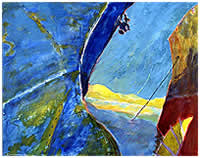
Ships with Windsurfers V
(Afternoon)
Private Collection, Vancouver BC
Copyright
David Haughton 2002-2010
Website by KitsMedia.ca